
1. What’s the Economic Climate in Mid‑2025?
The U.S. economy enters mid‑2025 amid contrasting signals.
- The labour market remains surprisingly resilient: jobless claims have declined to around 227,000, and unemployment hovers near 4.1%—levels indicative of strong employment conditions
- At the same time, GDP slowed sharply in Q1, with an annualized contraction (~–0.5%). Consumer sentiment dropped, while business confidence weakened as tariffs and policy uncertainty mounted .
2. Are We Heading Toward Recession?
✅ Signs of Strength
- Job growth remains stable, and the reduction in jobless claims suggests sustained demand for labour—even amid slower economic momentum.
- High-yield (“junk”) bond spreads have compressed to historically tight levels, signalling investor confidence and low recession expectations
- Prediction markets place recession odds at roughly 20%, down significantly from earlier in the year—reflecting improved sentiment after tariff pauses
⚠️ Warning Flags
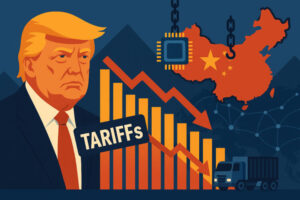
- Tariff uncertainty continues: new duties are poised to take effect in August, which could dampen consumption and inflate costs.
- GDP forecasts have been revised downward: the IMF now projects growth at 1.8% for 2025, down from 2.7%, raising the recession probability to ~40%
- Technical indicators point to risk: the yield curve inversion (a classic recession predictor) has recently reversed, and the Conference Board’s Leading Economic Index has declined for over 20 straight months
3. What Are Economists Saying?
👉 Moderate Downside Risk
- Deloitte and EY forecast growth slowing to 1.5%–1.9% in 2025, with recession risk estimated between 35–40%. Slower labor demand and elevated inflation challenges are key concerns
- J.P. Morgan researchers lowered recession odds to 40%, citing ongoing strength and believing the current cycle may extend into early 2026—though sub-par growth is possible
➕ Structural Resilience
- A recent Financial Times briefing described the boom-and-bust cycle as increasingly obsolete; aggressive fiscal and monetary policy in recent years have fostered longer expansions—even amid shocks like inflation and trade disruptions .
4. Key Economic Forces at Work
💡 Labor Market Trends
While the unemployment rate remains low, job additions have slowed, especially in private payrolls—suggesting early signs of labor market cooling. Adverse tariff policies and slowing hiring in high-cost sectors could intensify this trend .
📉 Inflation & Policy
- Tariffs could fuel inflation—consumer expectations are already elevated, with long-run inflation forecasts jumping to over 5% in mid-2025 .
- The Fed remains cautious: while markets anticipate rate cuts later in 2025, policymakers have flagged inflation risks tied to trade and fiscal uncertainty—delaying near-term easing decisions
🌐 Trade & Business Confidence
Uncertainty tied to trade disputes and evolving tariffs erodes business investment sentiment, even as some corporate profits remain solid—particularly in U.S. operations where resilience in hiring and revenues has surfaced recently
5. Recovery Momentum: What Could Drive Growth?
- Retail investor inflows are expected to deliver up to $500 billion into U.S. equities in H2 2025, potentially lifting markets by 5‑10% by year-end
- Stock market strength—with indices up over 20% since April—drives consumer wealth and confidence, which may support consumer spending even amid weakness elsewhere .
- Corporate earnings remain solid, particularly among defensive sectors like utilities and healthcare, reinforcing investor optimism in a late-cycle environment .
- Productivity gains tied to automation and AI may support mid-cycle expansion despite investment headwinds in other areas .
6. Scenario Outlook: Key Catalysts
| Scenario | Growth | Recession Risk | Economic Drivers |
|---|---|---|---|
| Base Case | ~1.5–1.9% GDP growth | ~35–40% | Stabilizing labor, modest inflation, investor inflows |
| Mild Recession | 0%–1% growth | ~50%+ by Q1 2026 | Tariff shock, bond market disruption, fiscal contradiction |
| Resilient Expansion | ≥2% growth | <20% | Trade de-escalation, Fed easing, strong consumer spending |
7. What It Means for You
- Consumers should watch inflation and labor indicators—if job growth stalls, precautionary saving may become more prudent.
- Investors could benefit from diversified portfolios—balance tech/AI growth bets with value plays in utilities, healthcare, and defensive sectors.
- Businesses should brace for potential demand softness, rising input costs, and credit volatility amid bond market stress.
- Policy watchers will be tracking fiscal debates closely—debt levels near $1T interest cost, which may limit stimulus capacity if downturn hits.
8. Final Take: Mixed Picture, Balanced Perspective
The U.S. economy in mid‑2025 is neither booming nor clearly in recession. Rather, it sits in a late-cycle transition: the job market remains resilient, corporate flow continues, and capital inflows support sentiment. At the same time, erosion in confidence, tariff uncertainty, technical recession indicators, and constrained policy flexibility pose meaningful downside risk.